If you've ever ordered racking based on a rough estimate—or worse, on what "looked about right"—you already know how costly that mistake can be. A miscalculation of just a few inches can mean thousands of dollars in wasted space, a failed municipal inspection, or a total system rebuild. That's not a lesson anyone wants to learn the hard way.
We'll walk through every step of the sizing process so you can make confident decisions before a single bolt hits the floor.
Are You Actually Storing Palletized Loads?
This might seem like a basic question, but it saves a lot of people from buying equipment they don't need.
If your team is primarily hand-stacking loose cartons, bins, or individual SKUs, you likely need industrial shelving—rivet shelving, steel shelving, or wire shelving—not heavy-duty pallet racking. Pallet racking is engineered specifically for forklift-operated, palletized bulk inventory.
If you're running forklifts and managing bulk pallet flow through a distribution, fulfillment, or manufacturing facility, you're in the right place. Let's get into it.
1: Start With What You're Storing (Building Your Load Profile)
Every racking decision—beam capacity, frame depth, upright height—flows directly from one thing: what you're putting on the rack. Getting this wrong at the start means correcting it at every step that follows.
The American Standard Pallet: 40" × 48"
In the United States, the GMA (Grocery Manufacturers Association) pallet is the supply chain standard. Unless you've confirmed otherwise with your suppliers or logistics partners, assume your pallets follow this specification:
- Dimensions: 40 inches wide × 48 inches deep
- Weight (empty): 35–50 lbs depending on wood density and moisture
- Rated load capacity: Up to 4,600 lbs of static weight for a quality wooden pallet in good condition
You'll also encounter CHEP (blue) and PECO (red) rental pool pallets throughout the US market. Both conform to the 40" × 48" standard and are built for repetitive heavy-duty use.
Industry-specific exceptions to know:
- Chemical industry: Often uses 48" × 48" square pallets for drum storage
- Beverage industry: Frequently uses 36" × 36" pallets for easier retail aisle maneuverability
- Import operations: Pallet sizes vary—always measure before ordering
Pallet Orientation Matters More Than You Think
Here's a detail that catches a lot of facility managers off guard: the direction a forklift picks up the pallet determines how it sits in the rack.
Standard selective pallet racking in the US assumes the forklift picks up from the 40-inch side, which means the pallet travels 48 inches deep into the rack bay. Your frame depth must reflect this. If you get the orientation wrong, your entire frame depth calculation is off.
Don't Measure the Pallet—Measure the Loaded Pallet
This is one of the most common and expensive mistakes in warehouse racking. You measure the wooden pallet, order your rack, and then realize your stretch-wrapped product overhangs the edge by 2 inches on every side.
That 40" × 48" pallet is now functionally 44" × 52" once loaded. If you haven't accounted for product overhang, your pallets will scrape against upright frames, block fire flue spaces, and potentially fail your NFPA inspection.
Action item: Measure your heaviest, most fully-loaded pallet in all directions before calculating anything else.
Weight Distribution: UDL vs. Point Loading
Knowing your maximum load weight isn't enough—you need to understand how that weight is distributed across the beam.
- Uniform Distributed Load (UDL): Standard for most palletized goods where weight spreads evenly across the beam length. This is what most standard beam ratings assume.
- Point Loading: Applies to heavy machinery, engine blocks, metal coils, or any concentrated weight in a small area. Point loads require specialized beams with significantly higher capacity ratings and structural decking.
If you're storing anything outside typical boxed goods, have a racking engineer evaluate your load profile before specifying equipment.
2: Sizing Your Upright Frames (Depth Calculation)
Upright frames are the vertical steel columns that form the backbone of your racking system. Getting the depth right ensures your pallets sit securely on the load beams—not on wire decking that isn't designed for primary weight support.
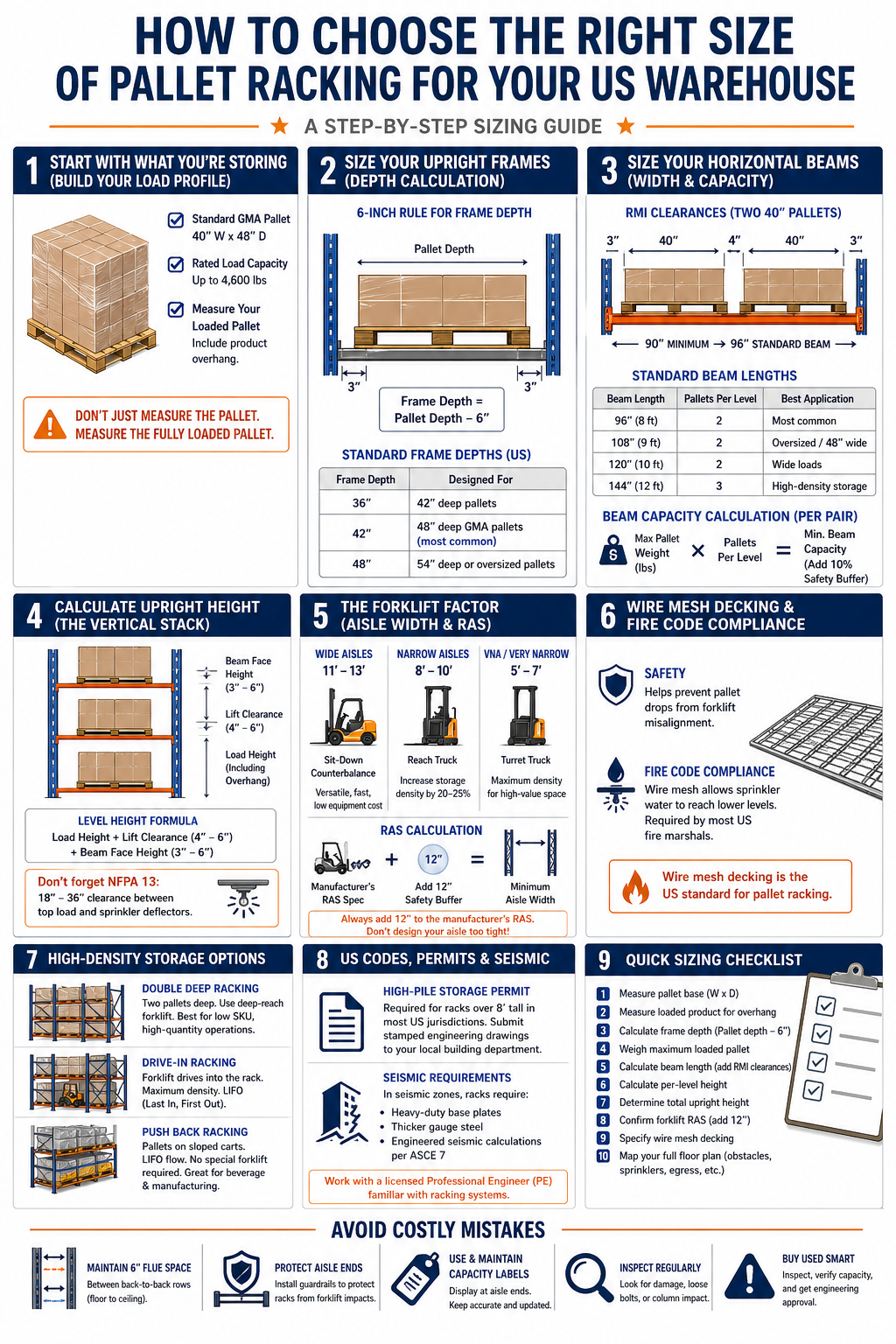
The 6-Inch Rule for Frame Depth
Your upright frame depth should allow the pallet to overhang the front and rear beams by approximately 3 inches on each side. This keeps the wooden runners of the pallet resting squarely on the load beams where they belong.
Formula: Frame Depth = Pallet Depth − 6 inches
Practical example: Standard 48" deep GMA pallets → 42" deep uprights (the most common frame size in the US market)
Standard Upright Frame Depths in the US
| Frame Depth | Designed For |
| 36 inches | 42-inch deep pallets |
| 42 inches | Standard 48-inch GMA pallets (most common US spec) |
| 48 inches | Oversized 54-inch deep pallets or custom loads |
Sticking to these standard sizes also has a practical benefit beyond engineering: you'll find replacement parts, add-on bays, and compatible accessories far more easily than with custom-sized frames.
3: Sizing Your Horizontal Beams (Width and Capacity)
Once your frame depth is set, the next calculation is beam length. This determines how many pallets sit side-by-side at each level and how much load those beams need to carry.
RMI Safety Clearances (Non-Negotiable)
The Rack Manufacturers Institute (RMI)—the governing body for racking standards in the US—requires specific clearances between pallets and frame columns. These aren't suggestions; they're the engineering foundation your beam length calculation rests on.
For standard selective racking with two 40"-wide pallets on a beam level:
- 3 inches between the upright column and the first pallet
- 4 inches between the two adjacent pallets
- 3 inches between the second pallet and the opposite column
Total beam length: 3 + 40 + 4 + 40 + 3 = 90 inches minimum → 96-inch (8 ft) beam is the US industry standard for two-pallet bays.
Standard Pallet Rack Beam Lengths
| Beam Length | Pallets Per Level | Best Application |
| 96" (8 ft) | 2 standard 40" pallets | Most common US warehouse configuration |
| 108" (9 ft) | 2 oversized or 48"-wide pallets | Heavy industrial, manufacturing |
| 120" (10 ft) | 2 wide loads | Furniture, appliance distribution |
| 144" (12 ft) | 3 standard pallets | High-density storage, lighter SKUs |
Calculating Beam Weight Capacity
Beams are sold and rated in pairs. To calculate the minimum capacity you need:
Required Beam Pair Capacity = Max Pallet Weight × Number of Pallets Per Level
Example: 2,500 lb max pallet weight × 2 pallets per 96" beam level = 5,000 lb minimum beam pair rating
Add a 10% safety buffer on top of that calculated minimum—this is standard US industry practice. In the example above, you'd specify beams rated for at least 5,500 lbs per pair.
4: Calculating Upright Height (The Vertical Stack)
This is where a lot of warehouses leave money on the table. Undersizing your uprights means wasted cubic footage. Oversizing means buying steel you can't use because of ceiling clearance codes. Getting the vertical calculation right is how you maximize your storage density legally.
The Level Height Formula
For each storage level, calculate:
Level Height = Load Height + Lift Clearance (4"–6") + Beam Face Height (3"–6")
Breaking it down:
- Load Height: Measure from the floor to the absolute highest point of your tallest fully loaded pallet—including stretch wrap and any stacked product.
- Lift Clearance: The forklift operator needs room to lift the load clear of the front beam before placing or retrieving it. Standard minimum is 4 to 6 inches above the load height.
- Beam Face Height: The physical height of the steel beam profile. Lighter-duty beams start around 3 inches; heavy-duty structural beams can reach 6 inches or more.
Example calculation:
- 60" load height + 5" lift clearance + 4" beam face = 69" per level
- Multiply by number of elevated levels, then add floor-level load height
US Ceiling Clearance Requirements You Can't Ignore
Two regulatory frameworks set hard limits on how high you can build:
NFPA 13 (National Fire Protection Association): Standard rules require a minimum of 18 to 36 inches of clear space between your top-tier inventory and the ceiling sprinkler deflectors. The exact requirement depends on your commodity class, storage type, and local fire marshal interpretation. Always confirm with your AHJ (Authority Having Jurisdiction) before finalizing your height calculations.
Physical obstructions: HVAC ducts, hanging warehouse lighting, structural trusses, and roof deck geometry all create hard ceilings beyond the code requirements. Map all overhead obstructions before specifying upright heights.
5: The Forklift Factor—Aisle Width and RAS Calculations
Here's the reality that many racking projects overlook until it's too late: your storage density isn't just determined by the racking itself. It's determined by the combination of racking and the forklift equipment you operate.
US Warehouse Aisle Width Classifications
Wide Aisles (11–13 feet)
- Equipment: Standard sit-down counterbalance forklifts
- Pros: Versatile, fast, low equipment cost, easy operator training
- Cons: Significant floor space consumed by aisle width—often 40–50% of total floor area goes to aisles
Narrow Aisles (8–10 feet)
- Equipment: Reach trucks or stand-up forklifts
- Pros: Reducing from 12-foot to 9-foot aisles can immediately increase storage density by 20–25% without adding square footage
- Cons: Higher equipment cost, more operator skill required
Very Narrow Aisles / VNA (5–7 feet)
- Equipment: Turret trucks or articulated forklifts (Bendi, Flexi, and similar)
- Pros: Maximum possible storage density—ideal for high-value real estate markets like Southern California, New Jersey, and the Chicago metro
- Cons: Highest equipment cost, may require wire guidance or rail systems, specialized operator certification
The Right Angle Stack (RAS) Calculation
Every forklift manufacturer publishes an RAS measurement—the minimum space required for that specific machine to turn 90 degrees with a fully loaded pallet.
Always add 12 inches to the manufacturer's RAS spec before finalizing your aisle width. This accounts for real-world operator variance, minor misalignments, and the fact that forklift performance specs are measured under ideal conditions.
If you specify aisle width based on a bare RAS number, you're designing a system where any imperfection causes a collision.
6: Wire Mesh Decking and Fire Code Compliance
Once your frames and beams are sized, you need to decide what sits between those beams for each storage level.
Why Wire Mesh Decking Is the US Standard
Wire mesh decking has become the dominant choice across American warehouses for two reasons that both matter enormously:
- Safety: If a forklift operator slightly misaligns a pallet, wire decking acts as a catch mechanism. It prevents partial or full pallet drops, which can be catastrophic at height.
- Fire code compliance: Unlike solid wood decking, wire mesh is permeable. When a fire suppression system activates, water from overhead sprinklers must reach inventory on lower levels to be effective. In the vast majority of US municipalities, local fire marshals legally require wire decking on pallet racking precisely for this reason. Solid decking blocks water flow and can cause your high-pile storage permit to fail inspection.
If you're replacing old wood decking, factor wire mesh into your project budget from the start—retrofitting later is doable but adds unnecessary cost.
7: High-Density Storage Systems (When Standard Selective Isn't Enough)
Standard selective pallet racking gives every pallet direct aisle access, which is great for facilities with many different SKUs. But if you're storing large quantities of the same product, high-density systems can dramatically increase capacity within the same footprint.
Double Deep Racking
Two rows of selective racking placed back-to-back, eliminating one aisle between them. Each bay holds two pallets deep rather than one. You need a deep-reach forklift with a pantograph mechanism to access rear pallets. Best for operations with low SKU counts and high quantities per SKU.
Drive-In Pallet Racking
Forklifts drive directly into the storage block on continuous side rails—there are no cross beams at each level. Maximum density, but operates on LIFO (last in, first out) inventory flow. Common in cold storage and frozen food facilities where density is the primary driver.
Push Back Racking
Pallets 2 to 6 positions deep sit on nested wheeled carts on inclined rails. Loading a new pallet pushes existing inventory back up the incline. Uses LIFO flow and requires no special forklift equipment—a standard reach truck handles it. Popular in US beverage distribution and manufacturing operations.
8: US Building Codes, Permitting, and Seismic Requirements
Installing pallet racking in the United States is a structural project, not just a furniture purchase. Depending on your state and municipality, failing to pull the right permits can result in forced removal, fines, and liability exposure.
High-Pile Storage Permits (IBC Requirement)
Under the International Building Code (IBC), racking taller than 8 feet requires a High-Pile Storage Permit in most US jurisdictions. To obtain one, you'll need to submit stamped engineering drawings that detail:
- Exact system dimensions and layout
- Load capacity specifications for all components
- Egress route compliance
- Fire suppression system compatibility
Work with a licensed professional engineer (PE) in your state who has experience with racking systems. The permit process timeline varies significantly by municipality—in some areas it takes weeks; in others, months.
Seismic Design Requirements
If your facility is in California, the Pacific Northwest, the New Madrid Seismic Zone (parts of Missouri, Tennessee, Arkansas, Kentucky), or anywhere with significant seismic risk, standard racking specs are not enough.
Seismic zone requirements typically mandate:
- Oversized, heavy-duty base plates to anchor uprights against lateral ground movement
- Thicker gauge steel—often structural steel rather than roll-formed
- Engineered seismic calculations specific to your zip code and facility class, required as part of your permit submission
The USGS Seismic Hazard Map is a useful starting reference, but your structural engineer will use ASCE 7 site-specific calculations for the actual design.
9: Your Complete USA Warehouse Racking Sizing Checklist
Use this step-by-step checklist before placing any racking order. Each step builds on the last, so don't skip ahead.
| Step | What to Do | Key Specification |
| 1 | Measure pallet base (width × depth) | Standard GMA: 40" × 48" |
| 2 | Measure loaded product for overhang | Add overhang to all dimensions |
| 3 | Calculate frame depth | Pallet depth minus 6 inches |
| 4 | Weigh maximum loaded pallet | Used for all beam capacity calculations |
| 5 | Calculate beam length | 2 or 3 pallets + RMI clearances (standard: 96" or 144") |
| 6 | Calculate per-level height | Load height + 4–6" lift clearance + beam face height |
| 7 | Determine total upright height | Level height × number of elevated levels; verify NFPA clearance |
| 8 | Confirm forklift RAS measurement | Add 12" to manufacturer's RAS spec for aisle width |
| 9 | Specify wire mesh decking | Required for NFPA compliance in most US jurisdictions |
| 10 | Map your full floor plan | Account for building columns, dock doors, sprinkler heads, egress paths |
10: OSHA Compliance and the Most Common Costly Mistakes
Even a properly sized racking system can fail an OSHA inspection or create serious liability if these details are overlooked.
Longitudinal Flue Space (Fire Code Requirement)
When two rows of selective racking are placed back-to-back, US fire codes require a minimum 6-inch vertical gap running floor-to-ceiling between the rows. This flue space allows heat and fire suppression water to travel vertically through the rack storage block.
Use engineered row spacers to maintain this gap consistently. Improvised solutions—wood blocks, zip ties, whatever's on hand—don't maintain consistent clearance and won't pass inspection.
End-of-Aisle Protection
Your floor plan needs to include room for floor-mounted end-of-aisle guardrails at every aisle terminus. These absorb forklift impacts that would otherwise hit the racking uprights directly. Skipping them is a significant OSHA citation risk, and a single unprotected forklift impact can compromise an entire row of racking.
The Risk of Buying Used Racking Without Documentation
Used racking can be a legitimate cost saver when purchased carefully. But uprights without clear, legible capacity labels are a compliance problem—and potentially a structural one. Steel that's been impact-damaged, incorrectly repaired, or subjected to years of overloading can look perfectly fine visually while being significantly weakened.
If you buy used: require documentation, inspect every column for damage indicators (bends, cracks, weld repairs), and have a qualified engineer sign off before installation.
OSHA Capacity Plaques: Required, Not Optional
Under OSHA regulations and RMI guidelines, every racking system must display load capacity plaques at the end of each aisle. These must be:
- Prominently visible
- Accurate to the actual installed system
- Updated any time the system is modified
Missing or inaccurate capacity plaques are among the most commonly cited OSHA racking violations in US warehouse inspections.
Frequently Asked Questions
What is the most common pallet rack beam size in the US?
The 96-inch (8-foot) beam is the most widely used configuration in American warehouses. It accommodates two standard 40-inch GMA pallets with proper RMI safety clearances on either side.
How deep should pallet rack uprights be?
For standard 48-inch deep GMA pallets, a 42-inch deep upright frame is the US industry standard. The 6-inch difference allows for 3 inches of pallet overhang on both the front and rear beams.
Do I need a permit for pallet racking in the US?
In most US jurisdictions, yes—if the racking exceeds 8 feet in height. The International Building Code (IBC) requires a High-Pile Storage Permit, which typically involves submitting stamped engineering drawings to your local building department.
What clearance is required between pallet racking and sprinklers?
NFPA 13 requires a minimum of 18 to 36 inches of clear space between the top tier of stored inventory and ceiling sprinkler deflectors. The exact requirement depends on your commodity class and local fire authority interpretation.
What's the difference between roll-formed and structural steel racking?
Roll-formed racking is manufactured from cold-formed steel sheets—lighter, more affordable, and sufficient for most standard US warehouse applications. Structural steel racking is made from hot-rolled steel (angles, channels, wide flanges), significantly heavier and stronger, and typically required in high-seismic zones or for extremely heavy loads.
Final Thought
The difference between a warehouse that operates smoothly for 20 years and one that requires costly mid-cycle modifications almost always comes down to how carefully the initial sizing was done.
Start with your actual inventory. Build your frame depth from your pallet depth. Size your beams from your pallet width and weight. Calculate your upright height from your load profile and ceiling constraints. Then map all of it against your forklift specifications and local building codes.
Done in that order, with accurate measurements at every step, you'll end up with a racking system that's safe, code-compliant, and built to support your operation's growth—not one you're retrofitting six months after installation.