When designing a safe and efficient storage system, choosing the right pallet is one of the most critical decisions a warehouse manager can make. However, simply looking at a pallet's "weight capacity" on a spec sheet is not enough to ensure safety. Pallets behave very differently depending on whether they are sitting on the floor, being moved by a forklift, or suspended in a rack.
To make the right equipment choices for your operations, you must understand the different types of load capacities, starting with the most fundamental metric: static loading.
What is Static Loading in the Warehouse Industry?
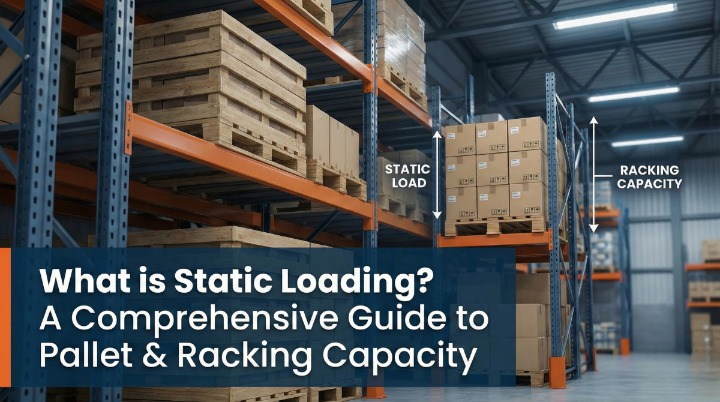
In the warehouse industry, “what is static loading” is defined as the maximum amount of weight a pallet can safely hold when it is completely stationary and resting on a solid, level surface, such as a concrete floor. Because the weight is evenly distributed across the ground, a pallet's static load capacity will always be its highest weight rating.
For example, if you place a pallet on the warehouse floor and stack heavy boxes on top of it, the weight of those boxes represents the static load. If you stack a second loaded pallet directly on top of the first one, the bottom pallet must have a static load capacity high enough to support the combined weight of everything stacked above it.
Static Loading vs. Dynamic Loading vs. Racking Loading
While understanding “what is static loading” in the warehouse industry is essential, logistics professionals rarely consider it in isolation. A pallet that safely holds 10,000 pounds on the floor might snap under a fraction of that weight when lifted. To select the right pallet for your operations, you must evaluate all three primary load types:
- Static Loading: As defined above, this is the weight capacity when the pallet is immobile on a flat, solid surface.
- Dynamic Loading: This is the maximum weight a pallet can safely support when it is in motion specifically when being lifted and moved by a forklift, pallet jack, or automated conveyor system. Because the pallet is only supported by the steel tines (rather than the entire floor), the dynamic capacity is significantly lower than the static capacity.
- Racking Loading (Edge Loading): This is the maximum weight a pallet can hold when placed in a selective racking system where only the outer edges of the pallet are supported by the rack beams. Because the center of the pallet is suspended in the air without support, this is the weakest point for any pallet and always represents the lowest weight rating.
Load Capacity Comparison Table
| Load Type | Operating Condition | Support Mechanism | Typical Capacity Ratio |
| Static Loading | Stationary on the floor | Fully supported by the ground | Highest (e.g., 10,000 lbs) |
| Dynamic Loading | In motion (Forklift/Jack) | Supported only by the steel tines | Medium (e.g., 4,000 lbs) |
| Racking Loading | Stored in an open rack | Supported only on two edges | Lowest (e.g., 2,000 lbs) |
How to Calculate Your Required Static Load (Block Stacking)
One of the most common reasons facility managers need to understand static loading is to safely execute block stacking (stacking loaded pallets directly on top of one another on the warehouse floor).
To prevent the bottom pallet from crushing, you must calculate the total static load it will bear.
- The Formula:
(Weight of one loaded pallet) × (Number of pallets stacked on top) = Required Static Load Capacity of the bottom pallet
- Real-World Example:
- You have a pallet loaded with goods that weighs 2,000 lbs.
- You want to stack them 4 pallets high on the floor.
- The bottom pallet sits on the floor, and there are 3 pallets stacked directly on top of it.
- Calculation: 2,000 lbs × 3 pallets = 6,000 lbs.
Conclusion: The bottom pallet must have a minimum static loading capacity of 6,000 lbs to safely support the stack. (Note: The weight of the bottom pallet itself is supported by the floor, not the pallet).
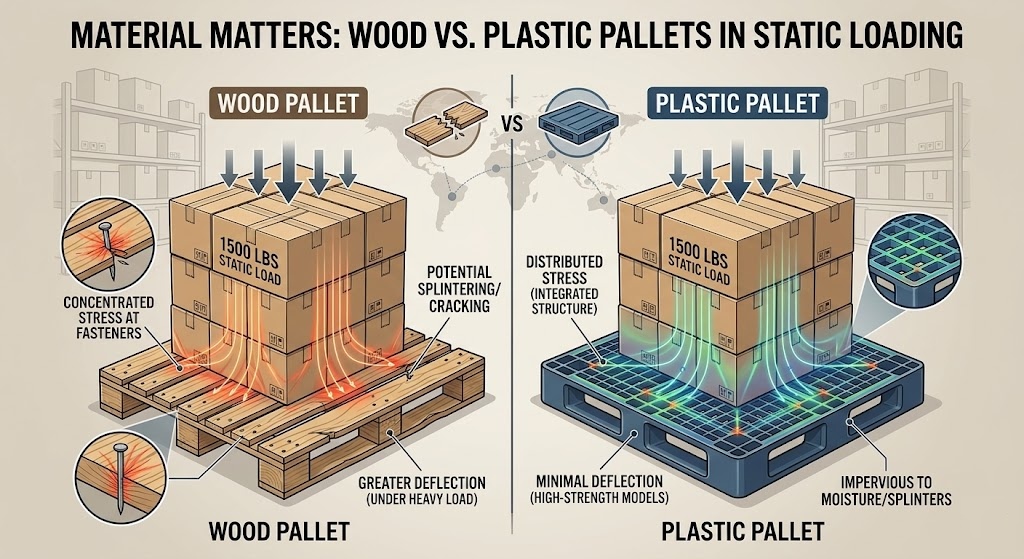
Material Matters: Wood vs. Plastic Pallets in Static Loading
The material of your pallet drastically impacts how it handles static loading in the warehouse industry over time:
Wooden Pallets
- The Pros: High-quality hardwood pallets are exceptionally strong and rigid, meaning they can handle massive static loads (often 10,000 lbs or more) without bowing.
- The Cons: Wood is susceptible to environmental factors. High humidity, moisture, or rot can weaken the timber, drastically lowering its effective static load capacity over time.
Plastic Pallets
- The Pros: Plastic pallets are immune to moisture and pests, meaning their static load capacity remains highly consistent throughout their lifespan. Heavy-duty plastic pallets can easily handle 10,000 to 30,000 lbs of static weight.
- The Cons: Plastic is susceptible to "creep" (gradual deformation). If an extremely heavy static load is left on a plastic pallet for months in a hot warehouse, the plastic may slowly warp or bow.
Why Understanding Static Loading in the Warehouse Industry Matters
If your pallets spend most of their time moving or in racks, you might wonder why static loading gets so much attention. Here is why it is a critical metric:
- Workplace Safety: Exceeding a pallet's static limit can cause the bottom boards to crack or plastic feet to buckle. A collapsed bottom pallet can bring an entire block stack crashing down, endangering warehouse staff.
- Preventing Inventory Damage: When a pallet fails under static pressure, the load shifts. This can crush the products on the lower tiers, leading to expensive inventory write-offs.
- Cost Efficiency: Buying pallets with heavy-duty racking capacities that far exceed your actual needs is a waste of capital. By accurately calculating your exact static, dynamic, and racking needs, you can procure cost-effective pallets that get the job done without overpaying for unnecessary structural reinforcement.
Best Practices for Maximizing Your Pallet's Load Capacity
To ensure your pallets safely reach their maximum static and dynamic potential, keep these operational realities in mind:
- Distribute Weight Evenly: Load capacities are calculated based on an evenly distributed load. If you place a heavy, dense object in the dead center of a pallet, it will fail at a much lower weight than its rated capacity.
- Inspect Your Flooring: Static loading assumes a perfectly flat, solid surface. Uneven concrete, debris, or grated flooring can create pressure points that drastically reduce a pallet's static strength.
- Check for Damage: Never use a pallet with cracked runner boards or warped feet at the bottom of a block stack. A damaged pallet's static loading capacity is completely compromised.
Conclusion: Build a Safer Warehouse
Understanding exactly what is static loading in the warehouse industry is the key to preventing pallet failure and maintaining a safe, cost-effective facility. Once you know your load limits, you need the right storage architecture to support your inventory.
At Racforce, we engineer industry-leading Pallet Racking Systems designed to handle your exact static, dynamic, and racking load requirements. Explore our custom storage solutions to maximize your warehouse footprint:
- High-Density Pallet Storage: Single Deep, Double Deep, Pallet Flow, and Drive-In Systems.
- Specialty Racking & Expansion: Cantilever Racks for long items, and space-multiplying Rack-Supported Mezzanines.
- Hand-Loaded Shelving & Picking: Boltless Shelving, heavy-duty Bulk Shelving, and multi-level Shelving-Supported Catwalks.