The American supply chain is experiencing an unprecedented era of expansion and modernization. From the massive, multi-million-square-foot distribution hubs in California’s Inland Empire to the densely packed fulfillment centers serving the Northeast corridor, the modern US warehouse is a marvel of logistics, efficiency, and high-density storage. At Racforce, we spend our days engineering, installing, and optimizing material handling equipment to help these facilities run at peak performance. However, as warehouses grow taller and the volume of stored combustible materials increases, we know that optimizing for space is only half the battle. You also have to optimize for safety.
Protecting these massive, high-value American facilities requires specialized, highly engineered fire protection solutions that meet strict local building codes. If you are involved in warehouse management, commercial real estate development, or logistics in the United States, you have undoubtedly encountered the acronym ESFR during facility planning or lease negotiations.
But what is an ESFR sprinkler system, and why has it become the absolute gold standard for high-clearance warehouse fire protection across the country? More importantly, how does your racking design dictate whether this system works or fails?
In this comprehensive guide, the team at Racforce will explore the mechanics, American regulatory history, and distinct operational advantages of the Early Suppression Fast Response fire sprinkler. We will dive deep into how these systems eliminate the nightmare of restrictive in-rack piping, why specific storage configurations like wire decking and clear flue spaces are legally mandated by US fire codes, and how you can partner with Racforce to optimize your facility for absolute compliance and safety.
1. The Evolution of Warehouse Fire Protection in the USA
To truly understand the value of an ESFR fire sprinkler system, we first need to look at the history of commercial fire suppression within the United States. For decades, standard spray sprinklers were the primary line of defense in American industrial facilities. These traditional systems operated on what fire engineers call a "control mode" philosophy.
In a control mode system, the goal of the sprinkler is not necessarily to immediately extinguish the fire. Instead, standard sprinklers are designed to wet the area surrounding the fire, preventing the flames from spreading to adjacent inventory or threatening the structural integrity of the steel building. The system "controls" the fire, keeping it manageable until the local municipal fire department arrives on the scene to fully extinguish it with high-pressure hoses.
However, as the US logistics industry rapidly evolved in the 1970s and 1980s, warehouses began to change dramatically. Ceilings got much higher, racking systems became denser, and the widespread American use of expanded plastics, shrink wrap, and cardboard packaging created environments where fires could grow with terrifying, explosive speed. Traditional control mode sprinklers mounted on a 30-foot ceiling simply could not produce water droplets large enough or fast enough to penetrate the intense updrafts (known as fire plumes) generated by these high-challenge, modern fires.
To combat this escalating national property risk, prominent American fire protection organizations and major commercial property insurers—most notably FM Global (Factory Mutual)—spearheaded extensive research and testing. This collaborative engineering effort birthed the Early Suppression Fast Response fire sprinkler in the late 1980s. Designed for "suppression mode," these revolutionary sprinklers were engineered to do what standard sprinklers could not: completely extinguish the fire at its source before the fire trucks even pulled into the loading dock.
2. What is an ESFR Sprinkler System? The Defining Mechanics
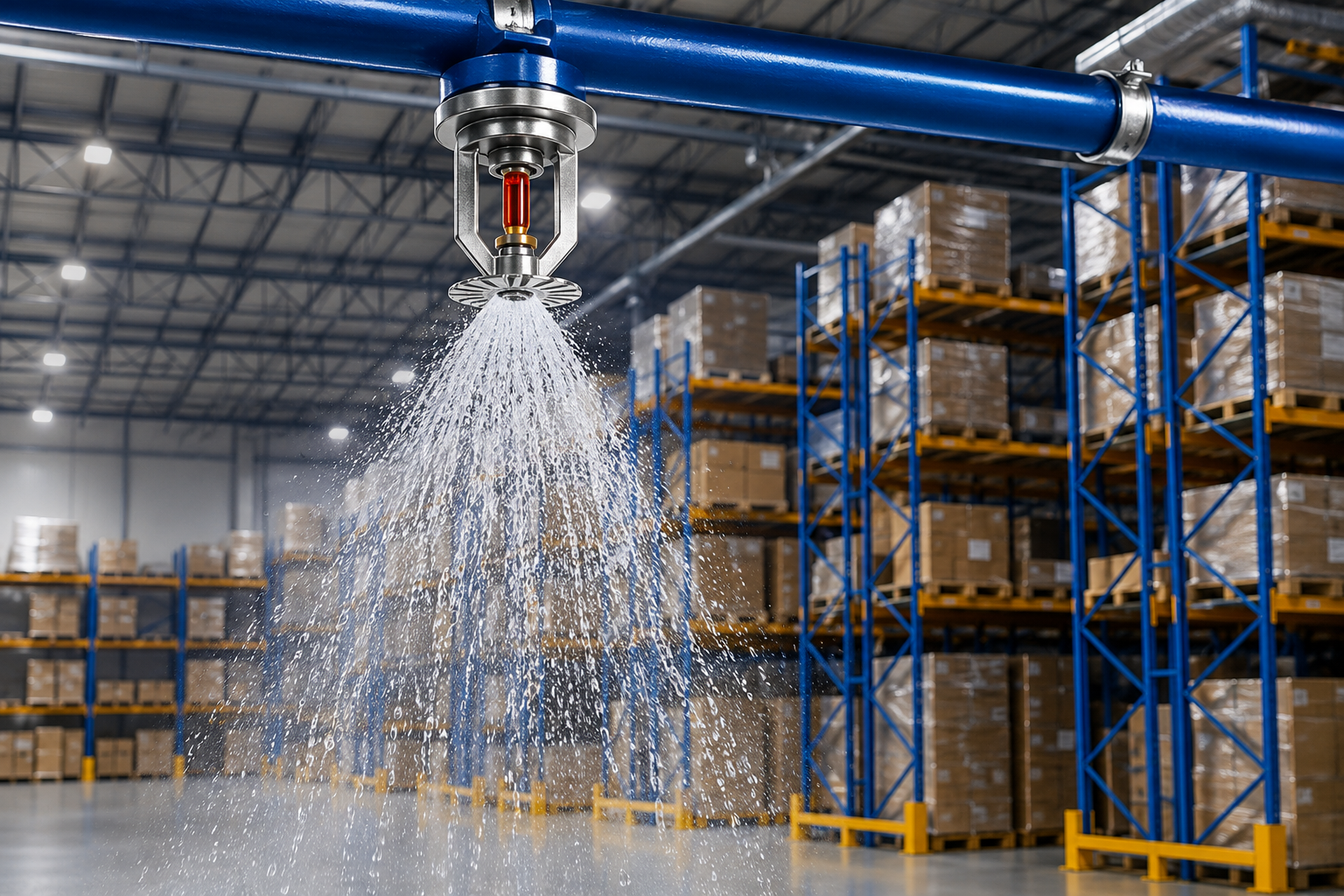
Defining the core question: what is an ESFR sprinkler system from a mechanical engineering standpoint? It is a specialized, ceiling-mounted fire suppression network that utilizes highly engineered, large-orifice sprinkler heads to discharge a massive volume of water directly onto a fire in its absolute earliest stages of development.
The "Fast Response" element refers to the thermal sensitivity of the sprinkler head itself. ESFR sprinklers are equipped with specialized, ultra-sensitive thermal elements (typically fast-response glass bulbs or low-mass fusible links) that react to ambient heat much faster than standard commercial sprinklers. When a fire ignites in the racks below, an ESFR sprinkler pops open rapidly, catching the fire while its thermal footprint is still relatively small and manageable.
The "Early Suppression" element refers to the sheer volume, pressure, and velocity of the water discharged. An ESFR fire sprinkler system operates at a much higher pressure and outputs significantly more gallons per minute (GPM) than a traditional standard-spray system. More importantly, the deflectors on ESFR sprinklers are specifically engineered to produce very large, heavy water droplets.
Why does droplet size matter to your local Fire Marshal? During a major warehouse fire, the flames generate a powerful, upward-moving column of hot gas known as a fire plume. Standard, fine water droplets will simply evaporate mid-air or be pushed laterally away by the thermal updraft. The massive, heavy droplets produced by an ESFR sprinkler possess enough downward physical momentum to punch right through that thermal plume, reaching the base of the fire to extinguish the fuel source entirely.
3. Standard Control Sprinklers vs. Early Suppression Fast Response Fire Sprinklers
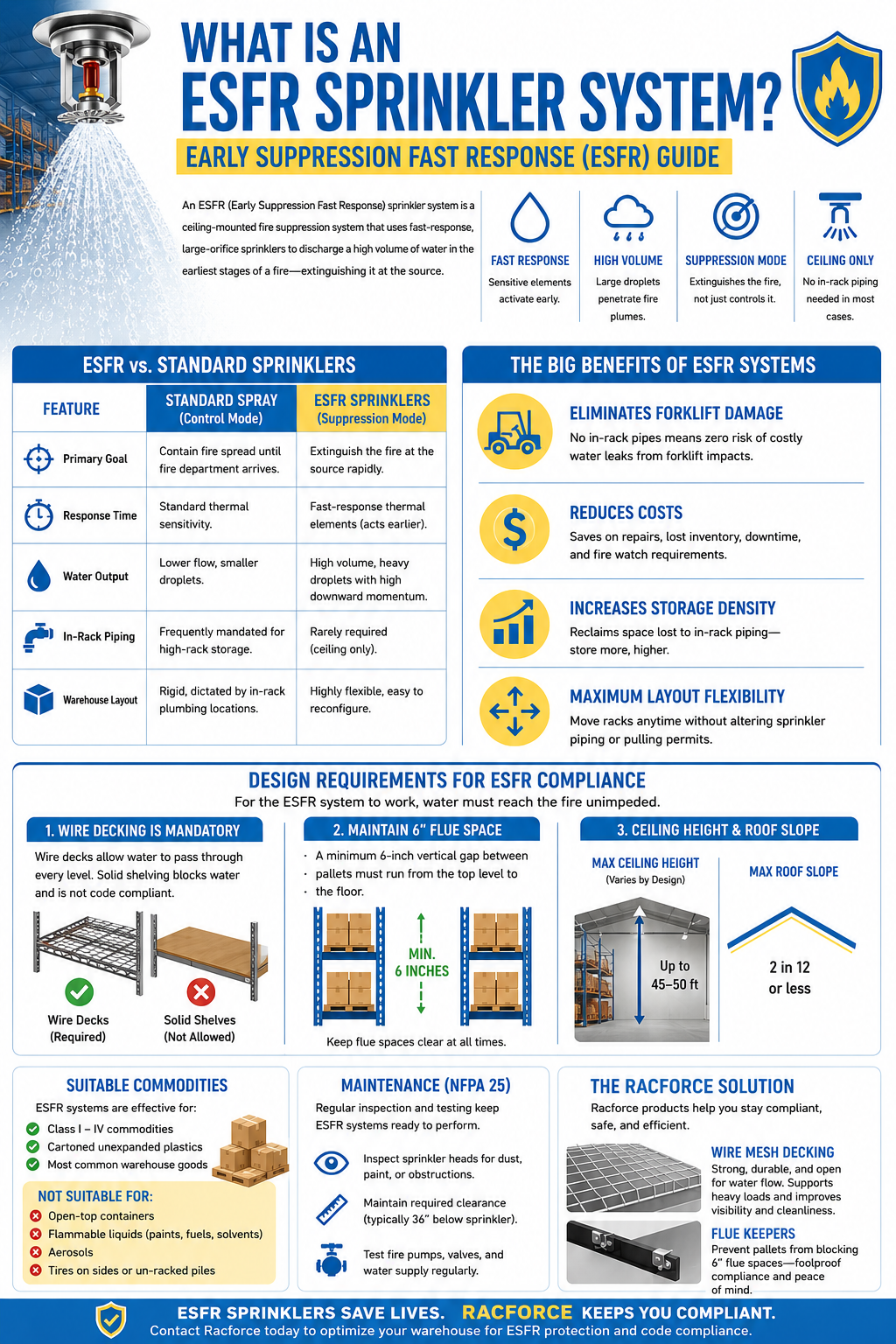
To highlight why American facility managers and property owners eagerly upgrade to ESFR systems—and why Racforce frequently designs racking systems specifically around them—it helps to compare them directly to traditional Standard Spray (Control Mode) Sprinklers:
| Feature | Standard Spray Sprinklers (Control Mode) | ESFR Sprinklers (Suppression Mode) |
| Primary Goal | Contain fire spread until the fire department arrives. | Completely extinguish the fire at the source rapidly. |
| Response Time | Standard thermal sensitivity (standard RTI). | Fast-response thermal elements (acts much earlier). |
| Water Output | Lower flow, smaller droplets. | High volume, heavy droplets with high downward momentum. |
| In-Rack Piping | Frequently mandated for high-rack storage. | Rarely required (operates entirely from the ceiling). |
| Warehouse Layout | Rigid, dictated by in-rack plumbing locations. | Highly flexible, easy to reconfigure for different tenants or operational needs. |
For a deeper dive into the specific US installation codes distinguishing these two systems, American fire protection engineers and racking integrators like Racforce rely on the rigorous standards set by the National Fire Protection Association (NFPA) 13: Standard for the Installation of Sprinkler Systems. This document is the legal foundation for commercial sprinkler and racking integration across all 50 states.
4. The Major Benefit: Maximizing Space and Eliminating In-Rack Hazards
The superior, property-saving extinguishing power of an ESFR fire sprinkler system is undeniably its most important life-safety feature. However, from a commercial real estate, material handling, and operational standpoint, the most significant financial advantage of upgrading to ESFR technology is what it allows you to remove from your warehouse: in-rack sprinkler pipes.
At Racforce, we see the real-world impact of warehouse design every single day, and we know that in-rack sprinklers are a massive pain point for facility operators.
The Nightmare of In-Rack Sprinklers
Before the invention of the Early Suppression Fast Response fire sprinkler, the only way to legally protect high-piled storage in the US (typically anything above 20 to 25 feet, depending on the commodity class) was to install a complex network of steel sprinkler pipes directly inside the pallet racking structure. These are known as in-rack sprinklers.
While highly effective at fighting fires, in-rack systems are a constant operational nightmare for American warehouse managers for several reasons:
- Extreme Vulnerability to Forklift Damage: This is the primary issue our material handling clients face. Forklift operators maneuvering heavy, cumbersome pallets in tight warehouse aisles inevitably make mistakes. When a 10,000-pound forklift accidentally clips a fragile in-rack sprinkler pipe, it can shear a head completely off. This releases hundreds of gallons of black, stagnant, foul-smelling water over your inventory before the main riser valve can be located and shut off.
- Costly Inventory Loss: The water damage caused by a single broken in-rack sprinkler head often far exceeds the cost of repairing the pipe. In a facility storing sensitive electronics, pharmaceuticals, or high-end consumer goods, a single forklift accident can ruin hundreds of thousands of dollars of inventory in minutes.
- Operational Downtime: When an in-rack system is damaged, the entire fire suppression zone must be shut down, drained, repaired, refilled, and hydrostatically tested by a licensed professional. During this time, your local Fire Marshal may require a costly "fire watch" (paying personnel to patrol the area 24/7), or worse, force your operations to halt entirely until the system is brought back online.
The ESFR Advantage: Ceiling-Only Protection
Because ESFR sprinklers release such a powerful, downward-driving column of water, they generally satisfy US fire codes without the need for any in-rack sprinkler pipes. By moving all the fire protection infrastructure to the ceiling, warehouse operators unlock massive, tangible benefits:
- Elimination of Forklift Damage: With no pipes woven through the steel pallet racks, the risk of a forklift causing a catastrophic water leak drops to absolute zero. This alone saves high-volume facilities tens of thousands of dollars annually in averted water damage, lost product, and pipefitter repair costs.
- Higher Storage Density: In-rack sprinklers require physical space within the racking structure (flue spaces must be artificially widened to accommodate the pipes and deflector clearance). Without them, that valuable real estate can be reclaimed. Facilities can often add additional storage levels or pack pallets tighter, maximizing the vertical and horizontal density of the warehouse—a crucial factor when US industrial rent prices are at all-time highs.
- Ultimate Layout Flexibility: Modern logistics demands agility. If you land a new e-commerce client or need to completely redesign your pick paths to accommodate new automation, moving pallet racks that have in-rack sprinklers requires hiring union pipefitters, pulling municipal permits, draining the system, dismantling, and rebuilding the plumbing network. With a ceiling-only ESFR fire sprinkler system, your racking is completely decoupled from your fire protection. The Racforce installation team can unbolt your racks and move them anywhere under the ESFR canopy without altering a single pipe or pulling a new plumbing permit.
5. Understanding US Commodity Classes and ESFR Suitability
While highly versatile, ESFR sprinklers are designed with specific types of storage in mind. American fire protection engineers and local Authorities Having Jurisdiction (AHJs) categorize stored goods into standard "Commodity Classes," ranging from Class I (non-combustible items stored on wood pallets) to Class IV (heavily combustible items) and high-hazard materials like Group A expanded plastics.
An ESFR sprinkler system is remarkably effective at suppressing fires fueled by Class I through Class IV commodities, as well as cartoned unexpanded plastics. The immense volume of water is specifically calibrated to handle the intense heat release rates of these materials, which make up the vast majority of consumer goods flowing through the US supply chain.
However, there are limitations under the International Building Code (IBC) and NFPA standards. ESFR systems are typically not suitable for:
- Open-top combustible containers (which can catch the massive volume of water and prevent it from reaching the fire burning below).
- Storage of highly flammable or combustible liquids (solvents, paints, fuels).
- Aerosol storage facilities.
- Tires stored on their sides or in massive, un-racked piles.
Always consult with a licensed, US-certified fire protection engineer (PE) to ensure your specific commodities are approved for protection under an ESFR ceiling system. For general guidelines on workplace fire safety and employer responsibilities regarding hazard recognition, OSHA's Fire Safety standards provide the foundational legal knowledge required for all US businesses.
6. Strict Design Requirements for American Fire Codes (The Racking Tie-In)
To reap the financial and operational benefits of having no in-rack sprinklers, you must respect the physics of how an ESFR fire sprinkler system works. Because all the water is coming from the roof, it must be able to travel completely unimpeded from the ceiling all the way down to the concrete slab.
If the water is blocked by the racking structure or the inventory itself, a fire on the ground level will continue to burn, generating enough heat to pop dozens of sprinkler heads, eventually overwhelming the facility's fire pump and water supply. Therefore, specific warehouse storage configurations are absolutely mandatory for an ESFR system to remain legally code-compliant in the USA. This is where Racforce’s expertise in material handling becomes critical.
A. Solid Shelving is Banned: Wire Decks Are Mandatory
One of the most critical rules enforced by US Fire Marshals operating under an ESFR sprinkler code is that the water must be able to pass seamlessly through the pallet rack levels.
For an ESFR fire sprinkler system to function properly and legally, you cannot use solid wood shelving (like plywood or particle board), solid steel plates, or metal grating with less than 50% open area. Think of solid shelving like an umbrella. If a fire starts on the bottom level of a rack, and the level above it is covered in solid plywood, the massive water droplets from the ceiling-mounted ESFR sprinklers will hit the plywood and pool, never reaching the flames below. The fire will spread laterally, unchecked by the suppression system, leading to total facility loss.
Because of this life-safety requirement, wire decks are mandatory. Wire decking consists of a galvanized or powder-coated steel wire grid that supports the weight of pallets and non-palletized inventory while boasting a high percentage of open area (usually exceeding 50% to 70%). When the ESFR sprinklers activate, the high-velocity water simply cascades through the wire mesh grid, penetrating layer after layer of the rack until it hits the fire source at the bottom. At Racforce, wire decking is one of our core specialties, ensuring our clients never fail a fire inspection due to improper shelving.
B. The Unforgiving Rules of Flue Space
In addition to ensuring the shelving itself is porous (via wire decks), you must also ensure there are vertical channels of empty space around the pallets themselves. These vertical gaps are called "flue spaces." Like a chimney in a fireplace, flue spaces allow hot air to vent upwards rapidly (popping the ceiling sprinkler head sooner) and, crucially, allow the heavy sprinkler water to travel straight down.
There are two types of flue spaces in an American warehouse rack design:
- Transverse Flue Space: The space between pallets sitting side-by-side in the same rack, or the space between a pallet and the steel rack upright column.
- Longitudinal Flue Space: The space between back-to-back rows of pallet racks.
The NFPA 6-Inch Rule: Under NFPA 13 standards for ESFR systems, warehouse operators must maintain a minimum 6-inch vertical gap in the transverse flue space (between pallets). This 6-inch gap must run completely unobstructed from the very top tier of storage all the way to the floor.
If forklift drivers push pallets too closely together, or if boxes shift in transit, fall off pallets, and clog this vertical space, the "chimney" is blocked. The heavy water droplets from the ESFR sprinkler will hit the blocked pallets and bounce off, failing to reach the lower levels where a fire might be raging. Maintaining this minimum 6-inch vertical gap is a non-negotiable requirement of US warehouse fire safety compliance. If a Fire Marshal inspects your facility and finds blocked flue spaces under an ESFR system, you will be cited, heavily fined, and potentially shut down until the issue is completely rectified.
C. Ceiling Height and Roof Slope Constraints
It is also worth noting that ESFR sprinklers have strict architectural limitations dictated by American building codes. Because they rely on the downward momentum of heavy water droplets, there is a maximum height at which they can be installed. Historically, ESFR systems were limited to buildings with 40-foot ceilings. Modern engineering advancements have pushed some specialized FM-Approved ESFR heads to protect up to 45 or even 50-foot ceilings, which is driving the current boom in "high-cube" warehouse construction across the US.
Furthermore, the warehouse roof cannot be steeply pitched. A steep roof allows the hot gas layer (the fire plume) to travel rapidly up the slope, potentially bypassing the thermal sensors of the ESFR heads located directly above the fire. This leads to delayed activation and allows the fire to grow out of control. Roof slopes generally cannot exceed a pitch of 2-in-12 for standard American ESFR installations.
7. The Racforce Solution: Optimizing Your American Warehouse for ESFR Compliance
Upgrading an older facility to an ESFR fire sprinkler system—or moving into a new build that already features one—is a massive leap forward in facility safety, insurance premium reduction, and operational efficiency. However, a million-dollar sprinkler system is only as good as the storage environment it protects. To ensure you remain compliant with local US fire codes, pass your annual Fire Marshal inspections without headaches, and guarantee that the system will work during a real emergency, you must invest in the right racking accessories.
At Racforce, we specialize in providing exactly what you need to marry your material handling system to your fire suppression system flawlessly.
To ensure both supreme safety and operational efficiency, wire mesh decks are the absolute ideal solution, and a cornerstone of Racforce’s product offerings. They replace dangerous, non-compliant solid shelving with robust, heavy-duty support for your inventory. The high-quality wire decks provided by Racforce are engineered to handle massive weight capacities (often exceeding 2,500 lbs to 3,000 lbs per deck) while maintaining the mandatory open area required for ESFR water to flow freely downward. Not only do they keep you legally fire-code compliant, but they also drastically improve warehouse lighting, cleanliness, and inventory visibility by allowing ambient light to pass through the rack levels.
Additionally, managing the legally mandated 6-inch transverse flue space can be a constant, daily struggle for warehouse managers. Turnover in forklift operator positions is high, and human error inevitably leads to pallets being pushed too close together or shoved too deep into the rack, blocking the longitudinal flue.
To solve this expensive compliance issue permanently, Racforce highly recommends outfitting your racks with flue keepers (also known in the industry as flue space spacers, rack safety straps, or pallet stops). These simple, highly effective steel devices or heavy-duty straps attach directly to the racking structure. They act as physical, rigid barriers that prevent pallets or loose inventory from being pushed too far back into the longitudinal flue, or sliding side-to-side into the transverse flue.
By letting Racforce install flue keepers, you essentially "foolproof" your racking system. You guarantee that your crucial 6-inch vertical gaps remain clear and unobstructed at all times, regardless of operator error or haste. When the Fire Marshal walks through your facility, uniform, perfectly maintained flue spaces send a clear message that your warehouse prioritizes life safety and strict code compliance.
8. Maintenance: Complying with NFPA 25
While an ESFR fire sprinkler system removes the severe headache of fixing broken in-rack pipes, it still requires rigorous, specialized maintenance to comply with US law. Because these systems operate at much higher pressures and volumes, any degradation in the system infrastructure can result in a catastrophic failure during a fire.
In the United States, the maintenance of these systems is governed by NFPA 25: Standard for the Inspection, Testing, and Maintenance of Water-Based Fire Protection Systems. Regular protocols for an ESFR sprinkler network include:
- Visual Inspections of Sprinkler Heads: Facility managers must ensure that the delicate, low-mass thermal elements on the ESFR heads are not covered in warehouse dust, paint, or grease. Any coating on the thermal element will insulate it, severely delaying the fast-response time needed to suppress a fire.
- Clearance Checks: There must be a strict minimum clearance between the top of the stored inventory and the deflector of the ESFR sprinkler (typically 36 inches under US code). If pallets are stacked too high on the top beam level of your Racforce racking, they obstruct the spray pattern of the heavy water droplets, ruining the suppression capability.
- Fire Pump and Valve Testing: Because ESFR sprinklers require massive water flow, the stationary diesel or electric fire pumps and water supply valves must be churn-tested and flow-tested regularly by licensed American fire protection contractors.
9. The Racforce Advantage: Tying It All Together
In summary, what is an ESFR sprinkler system? It is the ultimate American fusion of hydraulic engineering and commercial fire safety design for high-density logistics. By discharging a massive volume of large, high-momentum water droplets, an Early Suppression Fast Response fire sprinkler doesn't just control a warehouse fire until the fire trucks arrive—it absolutely crushes the fire at the source.
The operational and financial benefits of this technology are transformative for the US supply chain. By eliminating the need for delicate, space-consuming in-rack sprinkler systems, warehouse operators can banish the costly threat of forklift water-pipe damage forever. Facilities gain the freedom to maximize storage density, rapidly reconfigure rack layouts to suit new clients, and streamline their logistics operations without constantly pulling municipal plumbing permits.
However, this operational freedom comes with strict regulatory rules enforced by local Authorities Having Jurisdiction. To fully harness the power of an ESFR fire sprinkler system, facility managers must respect the physics of water flow and strict American fire codes. Solid shelves must be banished, and wire decks are mandatory to ensure unobstructed downward suppression. Furthermore, strict, daily adherence to the minimum 6-inch vertical flue space is required to create the chimneys necessary for water penetration.
This is where your choice of a material handling partner makes all the difference. By proactively investing in compliance tools like heavy-duty wire mesh decking and robust flue keepers from Racforce, American warehouses can fully leverage the protective power of their ESFR sprinklers. The result is a storage facility that operates with maximum efficiency, layout flexibility, lower insurance premiums, and unparalleled safety against the devastating threat of industrial fires.
Don't leave your code compliance to chance. Contact Racforce today to ensure your racking system is perfectly optimized to support your ESFR fire suppression network.