When designing or optimizing a warehouse layout, every square foot translates directly to your bottom line. With industrial real estate rates remaining historically high in major US logistics hubs from the Inland Empire to Dallas-Fort Worth and New Jersey facility managers are constantly fighting a tug-of-war between two competing priorities: storage density and accessibility.
Aisle width plays a major role in how efficiently your warehouse operates. From how many pallets you can store to the type of forklift you need and how quickly orders can be picked, your aisle layout has long-term implications for cost, productivity, and scalability.
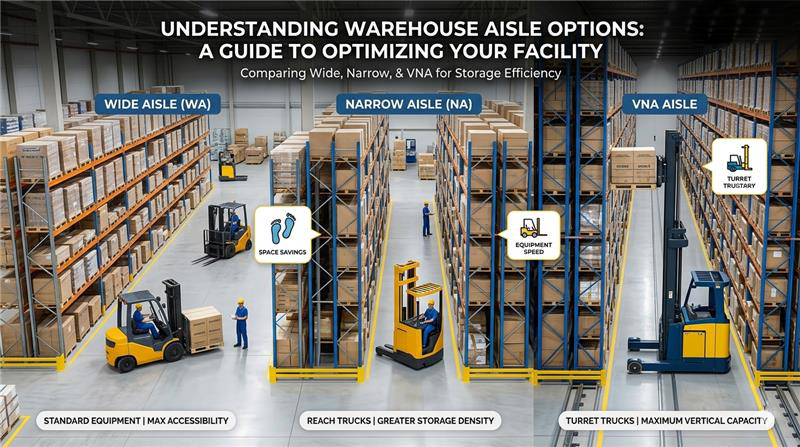
Let’s break down the definitions, the equipment requirements, US safety regulations, and the hidden operational costs of Wide, Narrow, and Very Narrow Aisle (VNA) racking to help you decide which layout best suits your facility.
The US Standard GMA Pallet
Before diving into the pros and cons, it helps to understand the technical specifications that drive US warehouse design.
In the United States, the vast majority of consumer goods move on the standard Grocery Manufacturers Association (GMA) pallet, which measures 48 inches deep by 40 inches wide. Because of this, standard warehouse racking upright frames are typically 42 inches or 48 inches deep.
A common misconception is that changing your aisle width means buying smaller racking. This is rarely true. The racks don't change; the distance between the rack structures does. By reducing the driving space, you drastically increase the number of 48x40 pallet locations you can fit inside your existing square footage.
Quick Comparison: Wide vs. Narrow vs. VNA Racking
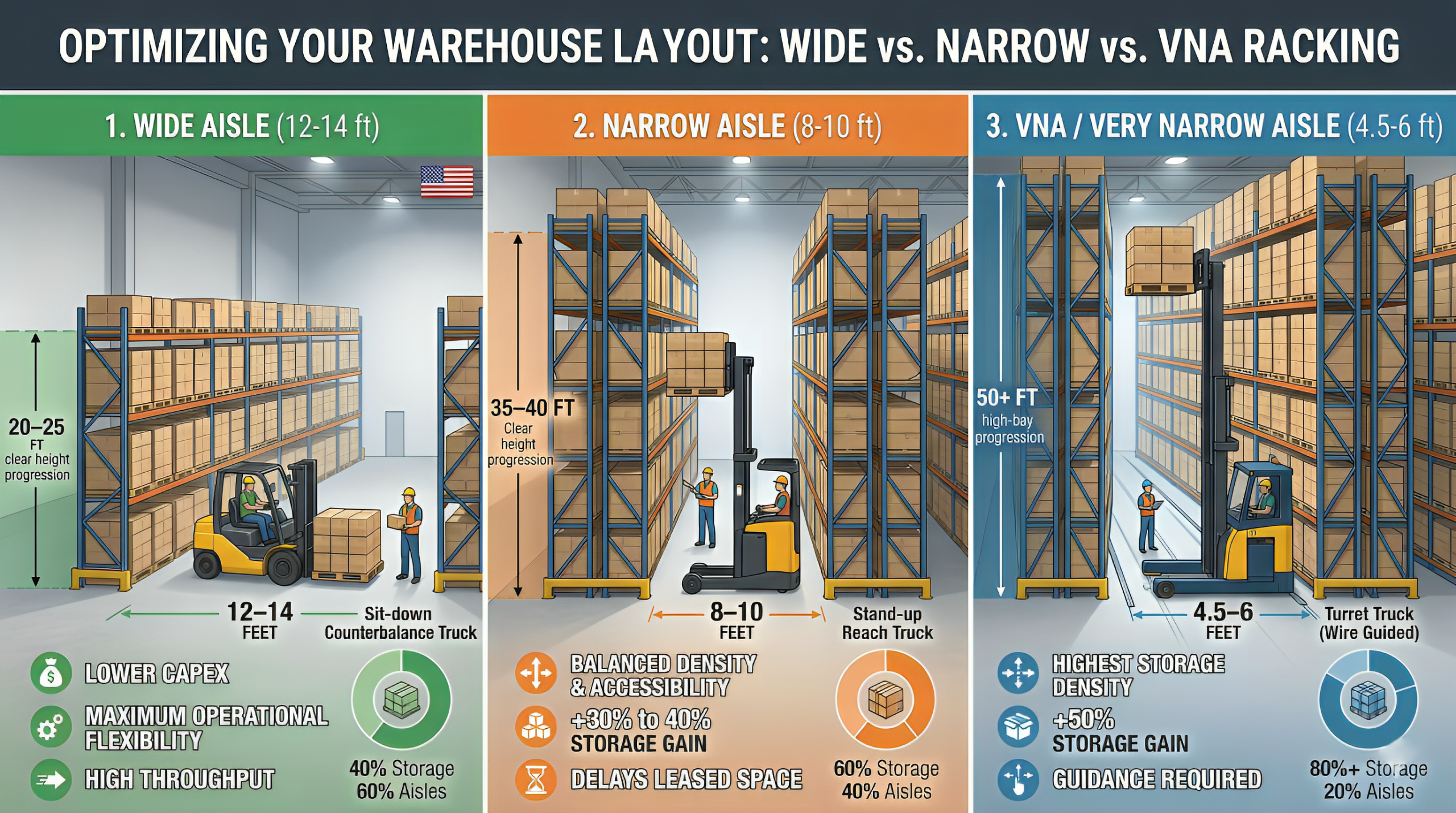
Here is a high-level overview of how the three main aisle layouts stack up against each other:
| Feature | Wide Aisle | Narrow Aisle | Very Narrow Aisle (VNA) |
| Typical Aisle Width | 12 to 14 feet | 8 to 10 feet | 4.5 to 6 feet |
| Floor Space Utilization | ~40% storage / 60% aisles | ~60% storage / 40% aisles | ~80%+ storage / 20% aisles |
| Storage Density Gain | Baseline (0%) | + 30% to 40% | + 50% or higher |
| Required Equipment | Sit-down counterbalance | Stand-up reach trucks | Turret or articulated trucks |
| Max Lift Height | Up to 20–25 feet | Up to 35–40 feet | Up to 50+ feet |
| Guidance System | None | None | Wire or rail guidance required |
| Speed & Flexibility | High (Fast, easy passing) | Medium (Careful navigation) | Low (Strict precision) |
| Upfront Cost (CapEx) | $ (Lowest) | $$ (Medium) | $$$ (Highest) |
| Best Suited For | High-turnover, 3PL, cross-docking | E-commerce, outgrown facilities | High-rent areas, cold storage |
1. Wide Aisle Racking
Wide aisle racking is the most traditional configuration found in American distribution centers, often chosen for its simplicity and flexibility.
- Typical Aisle Width: 12 to 14 feet.
- Best Suited For: High-throughput 3PLs, cross-docking facilities, fast-moving goods, and operations where speed is more important than maximum density.
The Advantages
- Lower Equipment Costs: Compatible with standard sit-down counterbalance forklifts, which are cheaper to buy, lease, and maintain.
- Operational Flexibility: Wide aisles are forgiving. They allow two forklifts to pass each other easily, reducing traffic bottlenecks during peak shift hours.
- Faster Navigation: Operators can pick, replenish, and fulfill orders faster without the constant fear of clipping a rack.
- Easy to Reconfigure: Simpler to adapt or tear down as your business operations evolve.
The Disadvantages
- Wasted Floor Space: Uses significantly more floor area than narrower systems. In a 100,000 sq. ft. facility, up to 60% of your floor might just be driving space.
- Lower Storage Density: Yields the lowest overall storage capacity, meaning you may require a larger, more expensive warehouse footprint to achieve your desired pallet count.
2. Narrow Aisle Racking
Narrow aisle racking strikes a practical balance between accessibility and space efficiency, making it incredibly popular for growing e-commerce fulfillment centers.
- Typical Aisle Width: 8 to 10 feet.
- Best Suited For: Warehouses that are outgrowing their current wide aisle layout but still need regular access to a wide range of SKUs without signing a lease on a new building.
The Advantages
- Increased Storage Density: Fits more racking within the same footprint, often increasing capacity by 30% to 40%.
- Good Accessibility: Still provides direct access to 100% of your pallet locations.
- Delays Relocation: A highly practical upgrade that maximizes existing floor space, saving the massive capital expense of a facility move.
The Disadvantages
- Requires Specialist Equipment: You must use stand-up reach trucks, which have tighter turning radii and improved lift heights.
- Higher Costs: Reach trucks require a higher upfront capital investment than standard sit-down forklifts.
- Slightly Slower Movement: Navigation requires more precision. Two reach trucks usually cannot pass each other in the same aisle, requiring strict one-way traffic rules.
3. Very Narrow Aisle / VNA Racking (Maximum Density)
Very narrow aisle (VNA) racking is designed to deliver the absolute highest possible storage density, pushing the limits of your building's clear height.
- Typical Aisle Width: 4.5 to 6 feet.
- Best Suited For: Large, high-bay warehouses with stable inventory profiles, cold storage (where chilling air is expensive), or sites in high-rent districts.
The Advantages
- Highest Storage Density: Offers the absolute best use of floor and vertical space.
- Ideal for High-Bay: Perfect for modern US facilities with 36-foot to 40-foot clear heights, allowing you to build incredibly tall rack structures.
- Great for Specific Inventory: Suitable for high-value or slow-moving stock that doesn't require constant, high-speed access.
The Disadvantages
- Highly Specialized Equipment: Relies entirely on swing-reach turret trucks or articulated forklifts.
- Guided Systems Required: These trucks almost always require wire guidance embedded in the concrete or physical steel rail guidance to ensure precise, safe movement.
- Reduced Flexibility: Once rail or wire systems are installed, changing the warehouse layout is incredibly difficult and costly.
US Compliance & Safety: OSHA and NFPA Considerations
When changing your aisle widths in the US, you aren't just dealing with space; you are dealing with strict federal and local regulations:
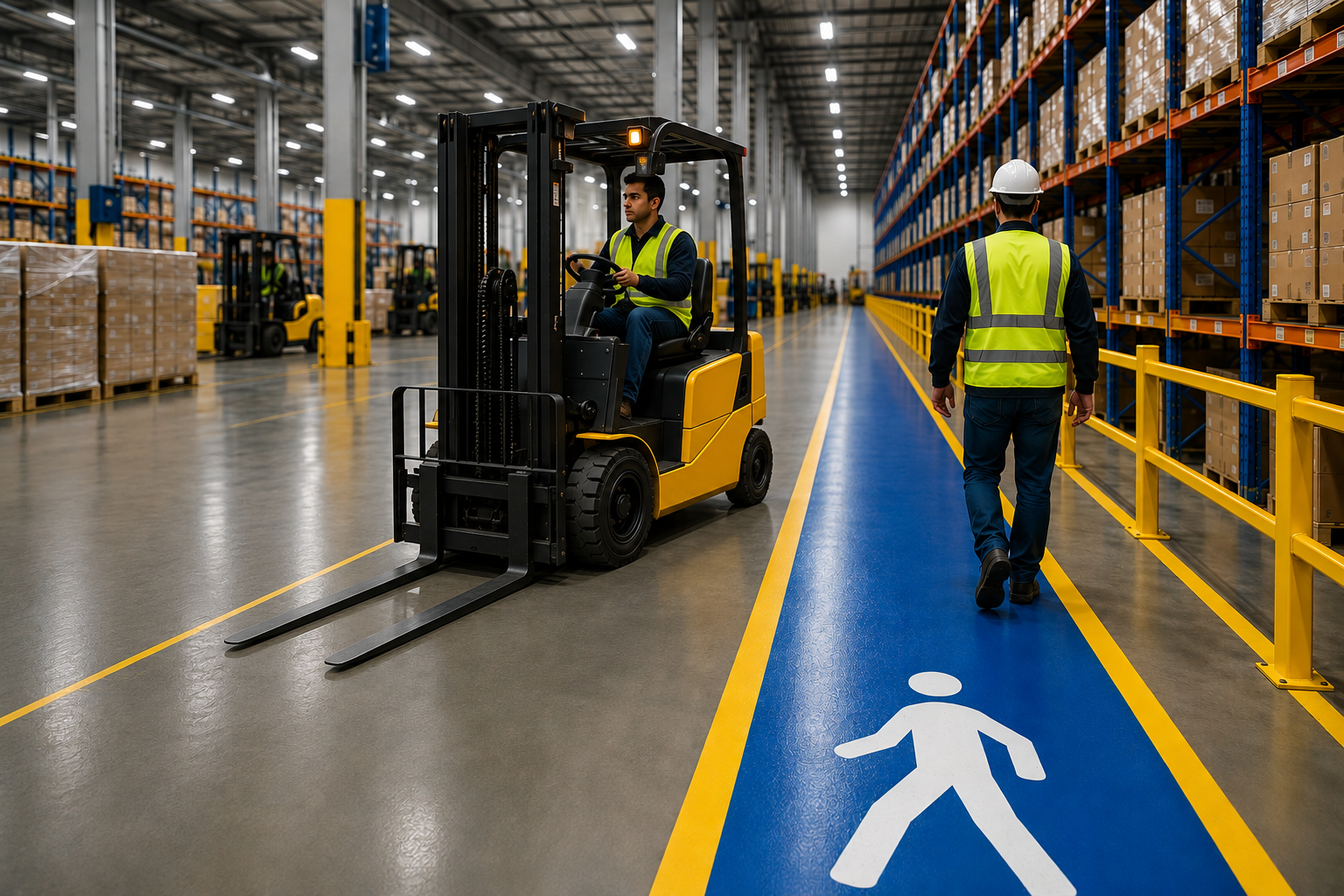
- OSHA Compliance: The Occupational Safety and Health Administration (OSHA) requires clear pathways for both forklifts and pedestrians. Narrowing aisles often means pedestrians and forklifts can no longer share the same space safely. You may need to implement strict "truck-only" aisles and dedicated pedestrian walkways.
- NFPA and Fire Codes: The National Fire Protection Association (NFPA) strictly regulates high-density storage. If you switch to a Narrow or VNA layout and build your racks higher to utilize vertical space, you may cross thresholds that require costly upgrades to your in-rack sprinkler systems (ESFR systems). Always consult your local fire marshal before changing rack heights or densities.
- Flue Spaces: Regardless of aisle width, US fire codes require transverse and longitudinal "flue spaces" (usually 3 to 6 inches of empty vertical space between pallets) to allow fire sprinkler water to reach the floor. Tighter aisles do not exempt you from flue space rules.
Calculating the ROI: Narrow Aisle Upgrade vs. New Lease
Before making a pitch to your executive team to switch to a narrow aisle layout, you need hard numbers. Buying new reach trucks is a large capital expense, but leasing a second warehouse is a massive long-term operational drain.
Here is a checklist to help you calculate if upgrading your current facility makes financial sense over a standard 3-to-5-year period.
1. Calculate the Cost of Leasing New Space (The Baseline)
- Annual Rent Increase: The cost of the additional square footage (e.g., 20,000 sq. ft. × $12/sq. ft. = $240,000/year).
- NNN (Triple Net) Fees: Annual costs for property taxes, building insurance, and common area maintenance.
- Utilities & Upkeep: Lighting, heating, cooling, and cleaning the new building.
- Relocation Costs (One-Time): Moving inventory, setting up IT/WMS, and installing new racking.
- Additional Labor: The cost of a second warehouse manager, security, or receiving team.
2. Calculate the Cost of the Narrow Aisle Upgrade (The Investment)
- New Equipment: The cost to purchase or lease stand-up reach trucks (typically ranging from $35,000 to $50,000+ each).
- Racking Reconfiguration: The labor costs from a material handling integrator to dismantle and re-anchor your existing racking into tighter 8-10 foot aisles.
- Operational Downtime: The cost of lost productivity during the 1–3 weeks it takes to safely reconfigure.
- Operator Training: Getting your current operators OSHA-certified on stand-up reach trucks.
- Fire Code Upgrades: Any required ESFR sprinkler updates to meet NFPA codes.
3. The Final Formula
Subtract your One-Time Upgrade Cost from the Total 3-Year Cost of Expansion.
If the cost of upgrading your current facility is less than the cost of funding a new building for three years, the Narrow Aisle project is financially justified. In many major US logistics markets, the high cost of real estate means new reach trucks pay for themselves in less than 18 months.
Frequently Asked Questions
How wide should warehouse aisles be?
Aisle widths range from around 4.5 feet for VNA systems up to 14 feet for wide aisle layouts. The "correct" width depends entirely on your forklift fleet, your 48x40 pallet load overhang, OSHA safety requirements, and your daily operational workflow.
What is the difference between narrow aisle and very narrow aisle racking?
The main differences are the aisle width and the equipment used. Narrow aisle racking (8-10 ft) uses reach trucks and balances access with density. Very narrow aisle (VNA) racking (4.5-6 ft) uses specialized turret or articulated trucks often guided by wires or rails to deliver maximum density at the cost of flexibility and a higher setup expense.
What type of racking is best suited for small parts?
Small parts are generally stored using industrial shelving, carton flow racks, or bin systems rather than traditional pallet racking. However, if your small parts are boxed and palletized, narrow aisle or VNA racking can be highly effective when space optimization is your top priority.