The modern American supply chain is a marvel of speed, efficiency, and scale. To meet the ever-increasing demands of e-commerce and global distribution, facilities are operating at a blistering pace. Inside these bustling fulfillment centers and distribution hubs, heavy machinery and human workers exist in a constant, high-energy state of motion. While material handling equipment—specifically forklifts, reach trucks, and automated guided vehicles (AGVs)—are the lifeblood of this operational efficiency, they introduce a severe, daily inherent risk to the workforce.
Forklift-pedestrian collisions are consistently ranked among the most devastating, traumatic, and tragically common workplace accidents in the industrial sector. Consider the simple physics of the environment: a standard warehouse forklift can easily weigh over 10,000 pounds when carrying a load, which is more than three times the weight of a standard passenger sedan. Furthermore, these machines feature rear-wheel steering that creates a wide, unpredictable tail swing, and operators frequently navigate with forward blind spots caused by massive, stacked pallets. When a machine of that immense size and kinetic energy meets a human worker, the machine does not simply stop on a dime, and the results are often fatal.
When it comes to protecting your most valuable asset—your people—strict compliance with OSHA warehouse rules is your first and most critical line of defense. However, achieving true warehouse pedestrian safety requires much more than simply reading the government rulebook to pass an annual safety audit. It requires facility managers to understand the life-saving intent behind the regulations, recognize the psychological behaviors of their workforce, and acknowledge exactly where "minimum legal compliance" leaves their team dangerously vulnerable.
In this exhaustive, comprehensive guide, the material handling and safety integration team at Racforce will break down the core warehouse pedestrian walkway requirements, analyze exactly what the Occupational Safety and Health Administration (OSHA) specifically mandates, and explain how you can permanently close the dangerous gap between basic regulatory compliance and absolute facility safety.
1. The Reality of Forklift Hazards in the Modern Warehouse
Before diving into the specific legal codes, it is vital to contextualize why pedestrian safety in a warehouse must be the foundational pillar of your operational strategy. According to data published by the National Safety Council (NSC), powered industrial trucks are responsible for tens of thousands of injuries every single year in the United States alone.
The logistics industry moves fast, and the pressure to meet throughput quotas can sometimes inadvertently encourage operators to cut corners or rush through crowded aisles. A pedestrian walking to the breakroom, a supervisor carrying a clipboard, or an order picker scanning barcodes are all completely exposed when sharing space with 5-ton vehicles.
Unlike a highway, where cars and pedestrians are separated by elevated sidewalks and concrete curbs, a warehouse is a shared, flat concrete slab. Without rigorous planning, strictly enforced rules, and highly visible boundaries, this shared space becomes a recipe for disaster. This is exactly why federal regulators step in to dictate how space must be managed.
2. The Legal Baseline: Understanding OSHA 1910.176(a)
When federal or state safety inspectors walk through your facility, their primary focus regarding pedestrian safety in a warehouse is governed by OSHA Standard 1910.176 - Handling Materials General. Specifically, subsection (a) covers the foundational requirements for aisles and passageways.
According to the official OSHA standard, employers are legally obligated to ensure that safe clearances are allowed for aisles, at loading docks, through doorways, and wherever turns or passage must be made. To maintain a safe working environment, the regulation explicitly dictates three main pillars of facility compliance:
- Aisles and passageways shall be kept clear and in good repair. * There shall be no obstructions across or in aisles that could create a hazard. * Permanent aisles and passageways shall be appropriately marked. While the language in OSHA 1910.176(a) is relatively brief, its implications are vast. Failure to adhere to these foundational OSHA warehouse rules is a guaranteed way to incur heavy federal citations, significantly increase your corporate insurance premiums, and, most importantly, put your workforce at an unacceptable daily risk.
3. Deconstructing the OSHA Mandates
To fully grasp the scope of your responsibilities, we must deconstruct what those three OSHA mandates actually look like on the warehouse floor.
"Clear and in Good Repair"
This directive means the physical infrastructure of your pathways—specifically the concrete slab—must be impeccably maintained. Potholes, severely cracked concrete, or uneven expansion joints are not just nuisances; they are active hazards. If a forklift carrying a top-heavy load hits a deep pothole, the vehicle can destabilize. This can cause the machine to tip over, or cause the heavy payload to slide off the forks and crash directly onto an adjacent pedestrian walkway. Keeping the floor in "good repair" is a direct prerequisite for warehouse pedestrian safety.
"No Obstructions"
An aisle cluttered with empty pallets, stray shrinkwrap, dropped cardboard boxes, or parked manual pallet jacks forces pedestrians to adapt. If a worker's designated pathway is blocked by debris, human nature dictates that they will simply step out of their safe, marked zone and walk into the active equipment lane to bypass the trash. The very moment a worker steps into the forklift traffic lane, they are in the danger zone. Housekeeping is not just about cleanliness; it is a critical safety enforcement mechanism.
"Appropriately Marked"
You cannot rely on verbal instructions, employee handbooks, or assumed "common sense" to dictate where people should walk and where 10,000-pound forklifts should drive. The separation between man and machine must be visually, clearly, and permanently defined on the floor itself.
4. Designing the Layout: Dimensions and the "3-Foot Rule"
To satisfy the "appropriately marked" clause of the OSHA standard, facility managers and material handling integrators must adhere to recognized industry best practices for designating separate areas for equipment and foot traffic. A critical part of this is determining the physical dimensions of your aisles.
When designing your warehouse layout, you must account for specific warehouse pedestrian walkway requirements regarding spatial width:
While OSHA does not provide a single, universal measurement for aisle width (because equipment sizes and load dimensions vary wildly from business to business), safety auditors heavily rely on a widely accepted industry standard known as the "3-foot rule."
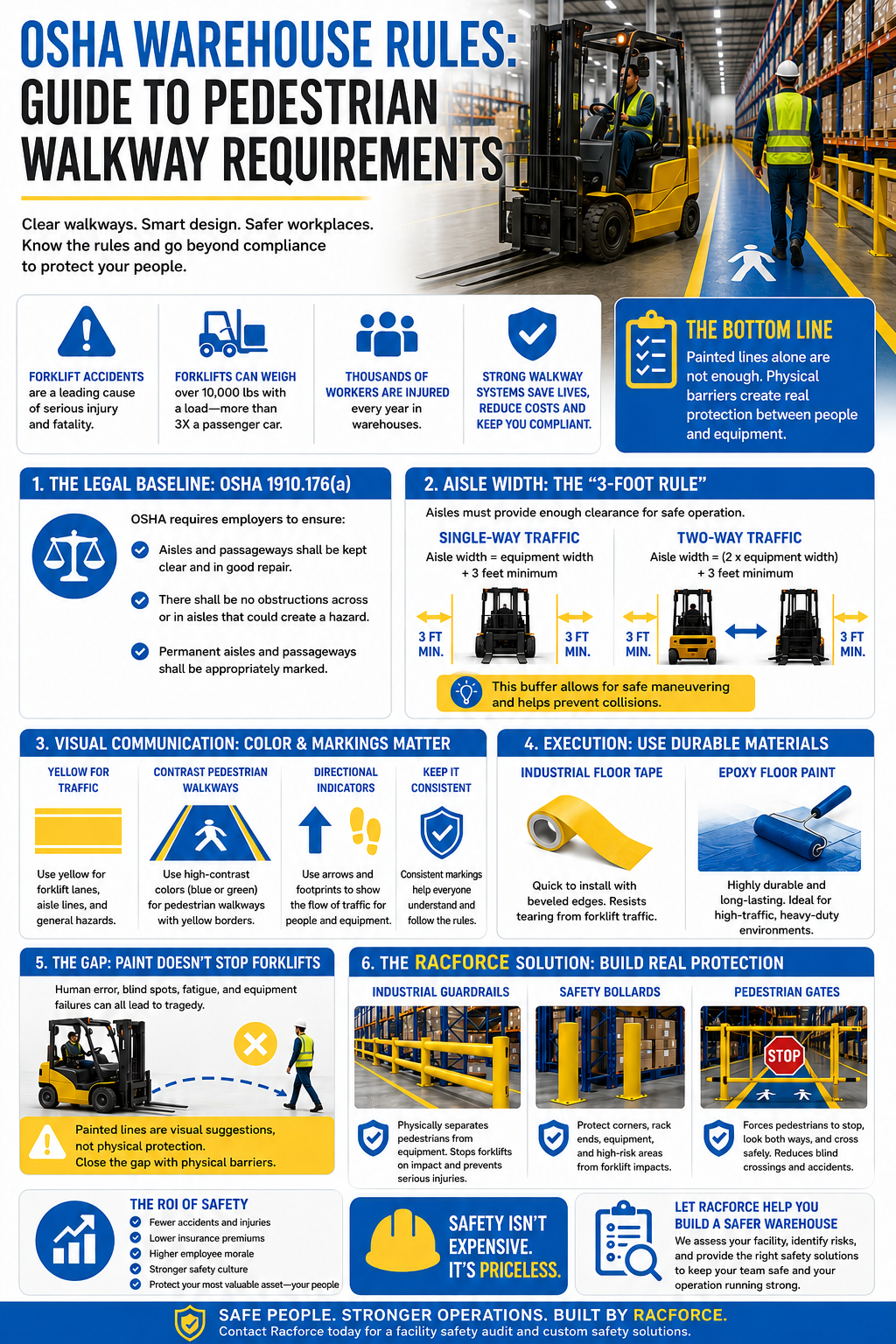
Primary traffic aisles should be at least 3 feet wider than the largest equipment used in that specific aisle, or 3 feet wider than the maximum load being carried (whichever creates a wider footprint).
- Single-Way Traffic: If your widest counterbalance forklift is 4 feet wide, your aisle must be a minimum of 7 feet wide. This allows the forklift to pass safely while leaving an adequate buffer zone.
- Two-Way Traffic: The math changes for bidirectional aisles. The aisle should be at least 3 feet wider than twice the width of your widest equipment. Therefore, two 4-foot forklifts mean an 8-foot total footprint, plus 3 feet of safety clearance, requiring an 11-foot minimum aisle width.
This vital 3-foot buffer ensures that if a forklift operator has to make a slight, sudden course correction—perhaps to avoid a piece of debris on the floor—they do not immediately scrape the racking system or clip a pedestrian who is walking on the edge of the adjoining lane.
5. Visual Communication: The Power of Color and Consistency
Beyond the width of the aisles, the way you mark those aisles is equally important. OSHA generally defers to the American National Standards Institute (ANSI) for guidelines on safety color codes to ensure universal understanding across the American workforce. Specifically, the ANSI Z535.1 standard provides the framework for visual safety communication.
- The Standard for Traffic: Under ANSI and OSHA guidelines, Yellow is the standard color for traffic lanes, aisle markings, and general physical hazards. The lines painted on your concrete to denote where forklifts belong should be bright, high-visibility industrial yellow.
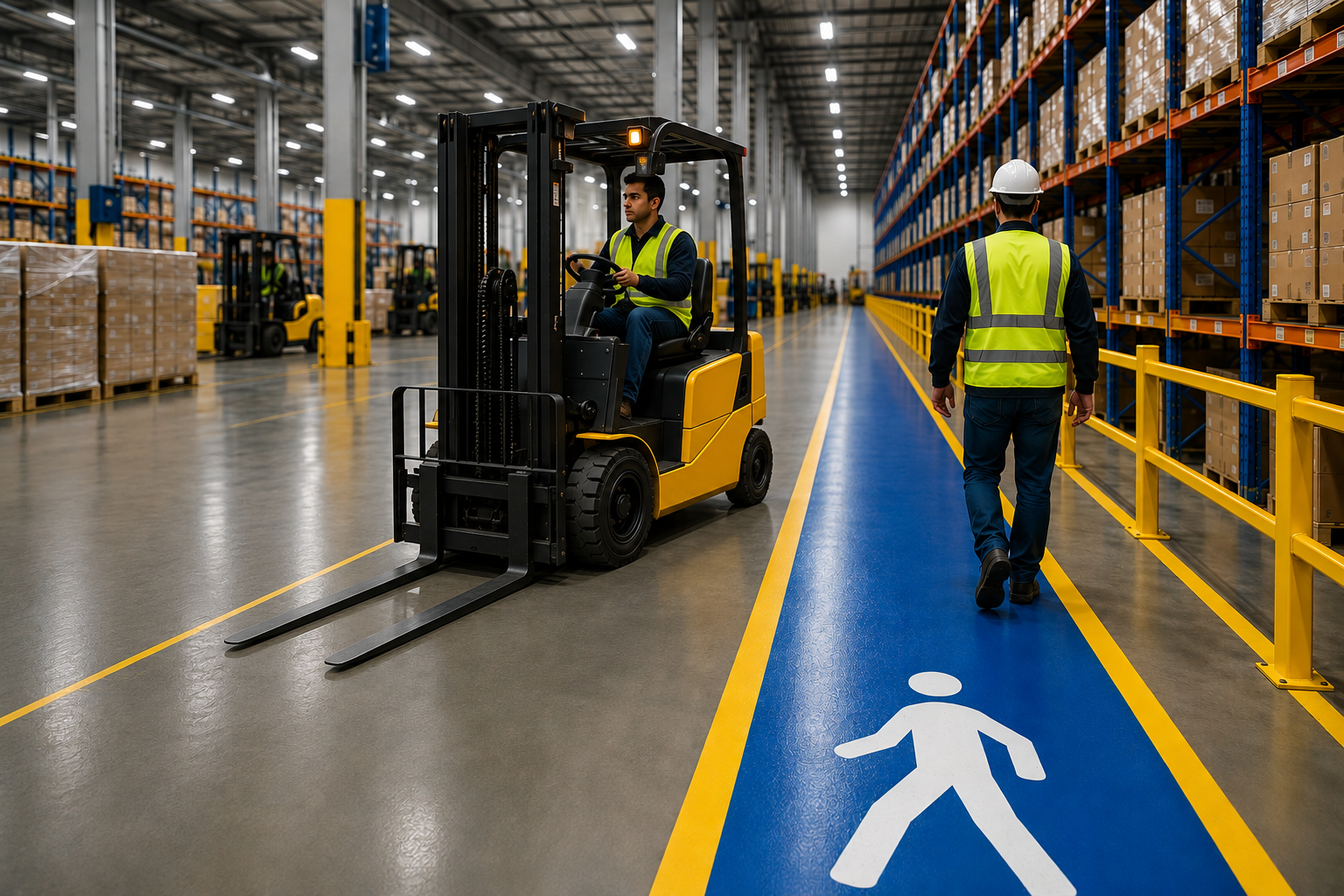
- High-Contrast Walkways: To make pedestrian zones unmistakably clear, best practices dictate painting the entire pedestrian walkway in a contrasting, solid color—such as industrial green or bright blue—and then outlining that path with stark yellow lines. This high-contrast visual cue screams to operators: This is a human-only zone. Do not cross.
- Directional Indicators: In addition to solid lines, many modern facilities utilize painted arrows to denote the flow of forklift traffic (one-way vs. two-way) and painted footprints to clearly direct pedestrian traffic flow toward exits, breakrooms, and time clocks.
6. The Execution: Choosing the Right Marking Materials
The OSHA standard states that permanent aisles must be appropriately marked. Temporary chalk, spray paint, or easily peeled painters tape might suffice for a one-week construction project, but they will not pass a facility safety audit. You must use industrial-grade solutions capable of withstanding the extreme abuse of a warehouse environment.
Facility managers typically choose between two primary methods for line striping:
- Industrial Floor Tape: Heavy-duty, industrial vinyl tape with beveled edges is a popular choice because it can be applied quickly without shutting down operations for curing times. High-quality tapes are designed to resist tearing even when forklift tires pivot directly on top of them.
- Epoxy Floor Paint: For a truly permanent solution, two-part epoxy floor paint or specialized urethane coatings are applied. Often, this requires shot-blasting the concrete first to ensure the paint adheres perfectly to the slab, ensuring it won't chip away when heavy pallets are dragged across the floor.
7. The Fatal Flaw: The Dangerous Gap Between Paint and Physics
Here is the harsh, unforgiving reality that we frequently discuss with our material handling clients at Racforce: OSHA regulations provide an excellent legal baseline, but they have a fatal flaw when it comes to the actual physics of moving machinery.
OSHA allows you to define your pedestrian walkways using high-visibility paint or heavy-duty tape on the concrete slab. But at the end of the day, paint does not stop a moving forklift.
A yellow line on the floor is merely a visual suggestion. It relies entirely on a perfect symphony of human behavior, operating on the assumption of two highly unpredictable variables:
- The forklift operator is paying perfect, unbroken attention 100% of the time.
- The pedestrian is staying perfectly within the lines and remaining hyper-aware of their surroundings 100% of the time.
In a real-world, high-volume warehouse, human error is an absolute, unavoidable certainty. Operators experience cognitive fatigue toward the end of long, repetitive 10-hour shifts. They deal with severe blind spots when carrying bulky, oversized pallets. They are pressured by throughput metrics that demand constant motion.
Furthermore, mechanical failures—such as a blown hydraulic hose, a failing brake line, or a blown tire—can cause a forklift to instantly lose control. Even environmental factors, like a spilled liquid on the concrete or condensation near an open loading dock, can cause a 5-ton machine to slide uncontrollably.
If a 10,000-pound machine veers off course at 8 miles per hour, that perfectly painted, ANSI-compliant yellow line will do absolutely nothing to protect the worker standing on the other side of it. This is the dangerous "gap" in basic compliance. Meeting the bare minimum OSHA warehouse rules keeps the government inspectors happy and prevents fines, but it does not guarantee actual, physical pedestrian safety in a warehouse.
8. The Psychology of "Facility Blindness"
To understand why pedestrians are so vulnerable even when walkways are painted, we must look at the psychology of the modern worker. Safety professionals refer to a phenomenon known as "facility blindness."
When a new employee walks onto a warehouse floor, they are highly alert. The noise is loud, the machines are intimidating, and their situational awareness is peaked. However, after walking the exact same path for six months, the environment becomes normalized. The loud beeping of reversing forklifts becomes white noise.
Workers become so accustomed to their environment that they stop looking for danger. They begin walking down the painted pedestrian lanes while staring down at clipboards, reading pick-tickets, looking at their mobile RF scanners, or checking their smartphones. Because they are "inside the lines," their brain tells them they are perfectly safe.
If a forklift operator miscalculates a turn and the forks swing over that painted line, the pedestrian, lost in "facility blindness," will have absolutely zero time to react.
9. The Racforce Solution: Engineering True Safety with Physical Barriers
To achieve total peace of mind, drastically reduce your liability, and protect your workforce from unthinkable tragedy, you must upgrade your facility from mere visual suggestions to physical guarantees. At Racforce, we believe that the only way to truly secure your pedestrian walkways and satisfy the highest standards of warehouse pedestrian walkway requirements is by installing heavy-duty, strategically placed physical barriers.
To close the safety gap and engineer out the risk of collision, we highly recommend integrating the following material handling and safety solutions into your facility layout:
A. Industrial Guardrails: The Ultimate Shield
Installing heavy-duty guardrails along your primary pedestrian walkways is the single most effective way to physically separate human workers from material handling equipment. A guardrail turns a painted walkway into a fortified tunnel.
- Steel Guardrails: Traditional corrugated steel guardrails are bolted deeply into the concrete slab using heavy-duty wedge anchors. These systems are rated to take a massive kinetic hit, stopping a forklift dead in its tracks before it can breach the pedestrian path.
- Polymer Guardrails: Modern, impact-absorbing polymer guardrails are becoming the industry standard. Instead of rigidly fighting the impact, these advanced plastics flex upon impact, dissipating the kinetic energy of the forklift. This not only protects the pedestrian but also minimizes whiplash injuries to the forklift operator, prevents severe damage to the vehicle, and stops the concrete slab from cracking at the anchor points.
B. Safety Bollards: Protecting the Pinch Points
At high-risk intersection points, loading dock doors, electrical panels, and the ends of rack aisles (where forklifts make tight, blind turns), steel safety bollards are absolutely essential.
These stout, floor-anchored posts act as an immovable final line of defense. When a forklift swings too wide at the end of an aisle, a heavy-duty bollard will deflect the forks, protecting vulnerable corners, pedestrian crossing zones, and expensive facility infrastructure from direct, catastrophic impacts.
C. Pedestrian Crossing Gates: Forcing Situational Awareness
There are inevitable points in any warehouse where foot traffic absolutely must cross an active forklift lane. A painted crosswalk on the floor is not enough, especially given the "facility blindness" we discussed earlier.
Self-closing pedestrian gates are the solution. These gates force workers to physically stop walking, push the gate open, assess the traffic in both directions, and make a conscious, active decision to enter the equipment zone. This simple mechanical intervention completely eliminates the hazard of pedestrians blindly "walking out" from behind a tall rack directly into the path of an oncoming vehicle. For advanced facilities, these gates can be equipped with electronic interlocks and flashing LED sensors that activate when a forklift is approaching the intersection.
10. The Financial ROI of Pedestrian Safety
While the moral imperative to protect human life is paramount, there is also a massive financial justification for going beyond basic OSHA warehouse rules and investing in physical barriers.
A single forklift-pedestrian accident can bankrupt a company. The immediate costs include massive OSHA fines, soaring workers' compensation claims, and complex personal injury lawsuits. The indirect costs are equally damaging: halted operations, plummeting employee morale, extreme turnover rates, and severe damage to your corporate reputation.
Investing in Racforce guardrails, bollards, and gates requires an upfront capital expenditure, but it yields a massive Return on Investment (ROI). By physically separating your equipment from your people, you drastically lower your risk profile. Many commercial insurance providers offer significant premium reductions for facilities equipped with heavy-duty physical barriers. Ultimately, safety equipment pays for itself the very first time a forklift bumps into a guardrail instead of a human being.
Elevate Your Safety Standards with Racforce
Do not let a strip of tape or a painted line be the only thing standing between your team and a catastrophic, life-altering accident. While adhering to standard warehouse pedestrian walkway requirements and OSHA warehouse rules is your legal and financial obligation, keeping your people alive, healthy, and confident in their work environment is your moral duty as an employer.
At Racforce, our material handling and safety experts specialize in assessing your facility's unique traffic flows. We walk your floor, identify your highest-risk zones, map out your blind spots, and design robust, physical safety barrier systems that integrate seamlessly with your operations and racking systems. We do not just help you pass OSHA inspections; we help you build an impenetrable safety culture where every single worker goes home safe at the end of their shift.
Stop relying on paint to do the job of steel and polymer. Contact Racforce today to schedule a comprehensive facility safety audit, and let us help you upgrade your pedestrian walkways with industry-leading guardrails, protective bollards, and automated safety gates. Because true safety is built, not painted.